What I’ve learned about debarking, chipping, and managing beetle-infested timber in Colorado’s mountain forests.
There’s something pretty unsettling about watching a forest die right in front of you.
Earlier this year, I was working in Evergreen, just off I-70, where I watched stands of green pine slowly turn red from spring into summer. Trees that looked perfectly healthy only months earlier were dying, and beneath their bark - mountain pine beetles. Before long, I found myself back in those same woods, helping remove the trees I’d watched decline.
It’s one thing to read about mountain pine beetle outbreaks. It’s another to watch them unfold, tree by tree, across a mountainside.
Mountain pine beetles are nothing new to Colorado. They’re native insects and have always played a role in our forests. But drought, overcrowded stands, and stressed trees have helped create conditions where populations can multiply. The beetles bore beneath the bark, reproduce, and feed on the living tissue of the tree, eventually killing it. By the time the needles turn red, the beetles may already be gone, looking for their next host, leaving behind swaths of fuel a wildfire would devour.
That’s something I’ve learned to pay close attention to. A dead tree isn’t necessarily an actively infested tree, and cutting down a tree with live beetles doesn’t necessarily solve the problem.
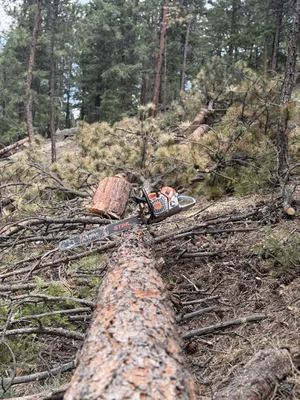
On another property in Evergreen, a windstorm had blown down roughly 50 trees. While working through the storm damage, I also felled five large pines that were actively infested. More recently, I’ve been working in Pine, Colorado, where I’ve felled over 60 trees, mostly standing dead timber, with some still harboring live beetles.
I’ve spent time peeling bark, running chippers, and figuring out how to deal with infested timber in places where getting equipment to the wood is half the battle. I’ve also worked on projects where another company is hauling timber away to a disposal facility for chipping.
And one thing has become pretty clear: getting the tree on the ground is often the easy part.
Beetles can continue developing beneath the bark of a felled tree. If that material isn’t properly treated before they emerge, you may have accomplished little toward controlling the infestation.
Debarking is one method I’ve used, particularly where steep terrain makes chipping or hauling difficult. The idea is simple enough: remove the bark and the living tissue where the insects develop, and you destroy their habitat. Done thoroughly and at the right time, it’s an effective treatment.
I’ve heard conflicting opinions about debarking during the fall and winter. My understanding has been that physically removing the insects’ habitat remains a sound approach, regardless of season, provided the work is done correctly and before emergence. But there’s a big difference between thoroughly debarking a log and just knocking off a few strips.
Solar treatment is another option, using heat trapped beneath plastic to kill developing beetles. It can work under the right conditions, but I’m skeptical of relying on it through a Colorado mountain winter. Short days, freezing temperatures, snow, and shaded slopes don’t exactly make for ideal solar heating. Without a proven treatment prescription, I wouldn’t want to gamble on it.
Chipping can be effective when the wood is reduced sufficiently to destroy the beetles and their galleries. But anyone who’s worked these mountains knows that getting a tree to a chipper isn’t always simple. Sometimes hauling material to a disposal facility makes more sense, though moving untreated infested wood introduces its own risk of spreading beetles if it isn’t handled and processed appropriately.
Winter gives us a valuable window to get this work done before the next flight season. But freezing temperatures alone aren’t going to take care of the problem. These insects are built to survive Colorado winters.
I’ve also learned that knowing when not to recommend treatment is just as important.
I recently visited a homeowner who had been told she might have mountain pine beetles on her property. We walked her acreage together, looking at trees and examining signs of previous attacks. A few had clearly been hit years earlier, but I couldn’t find evidence of current activity elsewhere on the property. That doesn’t guarantee beetles weren’t present, but I certainly wasn’t going to tell her she had an active infestation without evidence to support it.
Mike Goldblatt of Evergreen and previous coworkers at Forestwerx have taught me virtually everything I know about mountain pine beetles. I’m grateful for the knowledge they’ve passed along, and I carry it with me into the work I do through White Elk Forestry. There’s still plenty I don’t know, and I’m not afraid to admit that.
One of my favorite parts of this work is meeting homeowners who’ve taken it upon themselves to learn about their forests. Walking a property with someone who’s been researching beetles, asking questions, and paying attention to their trees makes for some good conversations.
And frankly, it’s encouraging.
Mountain pine beetles don’t care about property lines. What’s happening on one hillside can eventually affect the next. This isn’t something one homeowner, contractor, or county is going to solve alone. It’s a community-wide, county-wide, and statewide effort to manage an insect that’s become a serious problem across parts of Colorado’s Front Range.
We’re never going to eliminate mountain pine beetles, nor should we try to eradicate a native species. But we can make informed decisions, treat active infestations where it makes sense, and give our forests a better fighting chance.
The more time I spend working in these woods, the more I realize how much there is to learn.
And if there’s one thing I’m certain of, it’s that cutting the tree down is only half the job.
Chris
Owner-Operator
White Elk Forestry, LLC
whiteelkforestry.com
(207) 441-8299
chris@whiteelkforestry.com