There’s something interesting about starting a business when you don’t really know what you’re getting yourself into.
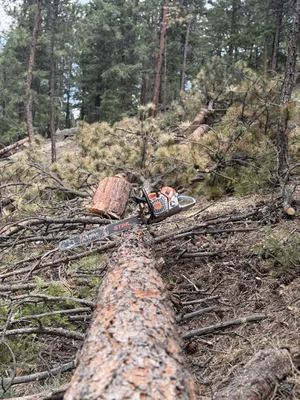
You have some experience, a few tools, a pickup truck, and enough confidence to believe you can make something of it. Then suddenly you’re not just the guy running a chainsaw anymore. You’re the accountant, estimator, salesman, equipment manager, administrator, and somewhere in between all of that, the guy who still has to show up in the woods and do the work.
That’s been my experience building White Elk Forestry. And I absolutely love it.
But I’d be lying if I said I knew what I was doing every step of the way.
I started this company with a few years of forestry and wildland firefighting experience, a background in physically demanding industries, and a genuine love for working in the mountains. I knew how to work hard, but knowing how to do the work and knowing how to run a business that does the work are two very different things.
Some mornings start long before sunrise, sitting at my computer figuring out insurance, accounting, marketing, or government contracting. Others start with sharpening chains, loading equipment, and heading into the mountains. Most days involve both.
I’m learning about organization, tracking production, understanding operating costs, and what a fair price actually looks like. Not just for the customer, but for the business and the people who help me get the work done.
I’ve underestimated jobs, lost bids, made mistakes, and spent countless hours trying to understand things I didn’t even know existed a few months earlier. I’m discovering that a business is a hungry animal. It constantly needs to be fed with time, attention, money, and energy.
And somehow, I keep wanting to feed it.
One thing I hadn’t fully appreciated was how much trust is involved in this work. When somebody invites me onto their property, they’re trusting me with something important to them. Sometimes it’s a home they’ve spent decades building around. Sometimes it’s land they’ve worked their entire lives to afford.
I’m learning to listen before offering solutions, to understand what people know and what they don’t, and to recognize when their concerns extend beyond the work they’ve asked me to perform.
I’m also learning to be comfortable admitting when I don’t know something.
There are people in this industry who have forgotten more about forestry than I’ve learned so far. I respect that, and I want to learn from them. I’d rather tell somebody I need to find an answer than confidently give them the wrong one.
I’ve also been thinking about leadership.
Right now, White Elk Forestry is a small, owner-operated company, but I have ambitions to build something much larger. And with that comes responsibility.
What kind of leader am I going to be? What kind of teacher?
There’s something intimidating about putting a chainsaw in somebody’s hands who has never operated one before. Their safety and development depend partly on your judgment, patience, and ability to teach. Knowing how to perform a task doesn’t automatically mean you know how to teach it.
Somebody once told me that certain people start businesses because they can’t work well with others. Then they find themselves responsible for leading people, and they still can’t work well with others.
That stuck with me.
I hope nobody ever thinks of me that way.
I want to surround myself with hardworking people, thoughtful people, and people who are better than me at things. I want to listen, learn, and build a company where everybody can earn a good living and take pride in their work.
Something else that’s surprised me is hearing people’s experiences with contractors. Deposits taken and jobs abandoned, promises broken, unnecessary work sold to unsuspecting homeowners. Some stories are difficult to believe.
And I realize that when I pull into somebody’s driveway, I’m a brown guy with a pickup truck and a chainsaw. I don’t have a fleet of equipment or decades of company history behind me. I’m just somebody trying to build something worthwhile.
I understand that trust isn’t automatic. I have to earn it.
By showing up, communicating, doing what I say I’ll do, and taking responsibility when things don’t go according to plan.
I think about where I want White Elk Forestry to go. Good people, good equipment, challenging projects, healthier forests, safer communities, and meaningful work protecting the mountains, wildlife, and people who call them home.
But I also think about where I came from.
A small-town, adopted Filipino kid who chased whatever interested him, worked on fishing boats, fought wildfires, and never particularly liked being told something couldn’t be done.
I’ve changed directions, taken chances, succeeded at things, and failed at others.
I don’t know exactly what this company will become. I have some pretty big dreams, but right now I’m still figuring things out one day at a time.
Learning to trust people, trust myself, and trust the process.
And if White Elk Forestry ever becomes everything I imagine it could be, I hope I never forget these early mornings, long days, mistakes, and the people who gave me a chance.
Because I’m not just trying to build a successful business.
I’m trying to build something I believe in, something I’m proud to put my name behind, and something that never forgets its roots.
Or my own.
Chris
Owner-Operator
White Elk Forestry, LLC
whiteelkforestry.com
(207) 441-8299
chris@whiteelkforestry.com