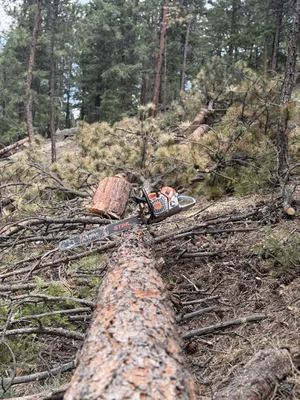
Building something worth putting my name on.
I’ve spent a good portion of my life doing work that most people would probably rather avoid.
Commercial fishing in Alaska, fighting wildfires, ironworking, falling timber in the mountains of Colorado. Long days, unpredictable conditions, hard physical labor, and plenty of situations where things don’t go according to plan.
I’ve never had much interest in sitting behind a desk. I’ve always preferred work where I can use my hands, solve problems, push myself, and look back at the end of the day knowing I actually accomplished something.
Starting White Elk Forestry was, in a lot of ways, the culmination of those experiences.
I wanted to build something of my own. Something that would challenge me, allow me to make a decent living, and give me a reason to keep getting up in the morning excited about the work ahead.
But more than that, I wanted to build a company that actually stood for something.
And that’s what I’m setting out to do.
There’s More to Forestry Than Cutting Down Trees
I love falling timber. There’s no point pretending otherwise.
There’s something about standing at the base of a tree, studying its lean, weight, structure, and surroundings, developing a plan, and executing that plan safely that I find incredibly rewarding.
It’s demanding work. It requires patience, experience, good judgment, and the ability to recognize when something isn’t going to work the way you expected.
But as much as I enjoy cutting timber, I don’t want White Elk Forestry to be known simply as a company that cuts down trees.
Because forestry is a hell of a lot more complicated than that.
A healthy forest isn’t necessarily a forest where every tree is standing. And a heavily thinned forest isn’t automatically a healthy one, either.
There’s a balance to be found.
Understanding competition between trees, species composition, forest structure, insects and disease, wildfire behavior, and the long-term effects of management decisions is what makes this industry so interesting to me.
The more I learn, the more I realize how much there is left to understand.
I don’t claim to be an expert in every aspect of forestry. I’m not a professional forester, and I’m not going to pretend that owning a chainsaw and knowing how to fall timber makes me one.
But I take the work seriously. I want to keep learning, work alongside people who know more than I do, and become the kind of contractor who understands not just how to perform a treatment, but why that treatment matters.
I want to be as good at understanding which trees should stay standing as I am at putting the others on the ground.
Colorado’s Forests Have a Lot of Work Ahead of Them
Anyone who spends much time in Colorado’s mountains can see that our forests are dealing with some serious challenges.
Wildfire, drought, beetle infestations, disease, overcrowded stands, and decades of changing land-use and fire-management practices have left plenty of work to be done.
And the reality is, we’re not going to fix all of it overnight.
There’s no magic piece of equipment, no single prescription, and certainly no one contractor who’s going to solve every problem.
But that doesn’t mean we shouldn’t be out there doing the work.
I believe active forest management has an important role to play in improving forest health, reducing hazardous fuels, protecting communities, and helping our forests adapt to changing conditions.
That doesn’t mean cutting everything in sight.
It means being deliberate.
Sometimes it means thinning an overcrowded stand to give the remaining trees a better chance. Sometimes it means removing dead or diseased timber before it becomes a bigger problem. Sometimes it means reducing ladder fuels around a home, improving access for firefighters, or clearing a hazardous tree that’s been hanging over someone’s driveway for years.
And sometimes it means recognizing that a particular area is doing just fine without our interference.
Every property is different. Every forest is different.
I want White Elk Forestry to approach that work with some common sense, a willingness to listen, and enough humility to recognize that there’s always something more to learn.
I Want to Make Forestry Work for Regular People
One thing I’ve noticed since starting this business is that there’s a pretty significant gap between recognizing that your property needs work and actually knowing what to do about it.
A homeowner might have five acres of dense ponderosa pine, a bunch of standing dead trees, beetle activity, or years of accumulated slash.
They know something probably needs to be done.
But where do they start?
Who do they call? What should they remove? What should they leave? Do they need a forester? A tree service? A logging contractor? A skid steer? A chipper?
And how much is all of this going to cost?
It’s a lot to figure out, especially for someone who doesn’t spend their days working in the woods.
I’d like White Elk Forestry to help make those decisions a little easier.
I want to be able to walk a property with someone, hear what they’re concerned about, discuss what they’re hoping to accomplish, and help them figure out a realistic way to get there.
Not everyone has the budget to completely overhaul their property in one shot.
That’s fine.
Maybe we tackle the most hazardous trees first. Maybe we focus on defensible space around the house this year and work farther into the property next year. Maybe we develop a longer-term plan that allows the landowner to make steady improvements over time.
I’d rather help someone accomplish something meaningful with the budget they have than convince them they need to spend money on work that doesn’t make sense.
I’m running a business, and obviously that business needs to make money.
But I also believe you can make a good living doing good work without trying to squeeze every last dollar out of the people who hire you.
That’s the kind of reputation I want to build.
Small Company. Big Ambitions.
Right now, White Elk Forestry is a small operation.
I’m the owner, the estimator, the sawyer, the equipment operator, the guy answering emails at night, and usually the guy covered in sawdust at the end of the day.
Some days I’m writing proposals for government contracts. Other days I’m dragging brush, sharpening chains, fixing equipment, or figuring out how to move several thousand pounds of timber without spending a fortune on machinery.
There’s nothing particularly glamorous about it.
Starting a business from scratch means wearing a lot of hats, making mistakes, spending money you wish you didn’t have to spend, and occasionally wondering what the hell you’ve gotten yourself into.
But I like it.
I like being responsible for the outcome. I like knowing that if something goes well, it’s because I made it happen. And if something goes wrong, it’s on me to figure out how to make it right.
I have ambitions to grow White Elk Forestry.
I’d like to own more equipment, develop the ability to handle larger projects, and eventually put together crews of skilled people who take the same pride in their work that I do.
I’d like to be involved in larger forest restoration projects, hazardous fuels reduction, timber operations, and conservation work throughout Colorado and the surrounding states.
But I’m not interested in growing just for the sake of getting bigger.
I don’t need a fleet of trucks with my logo on the doors to feel like I’ve accomplished something.
If White Elk Forestry grows into a larger operation, I want it to be because we’ve earned the work, developed the skills, and built the relationships to support it.
And if it stays a relatively small, specialized forestry company that does difficult work exceptionally well?
I’d be pretty damn proud of that, too.
I Believe There’s Room for a Different Kind of Contractor
Forestry is an industry where equipment matters.
Production matters. Efficiency matters. Experience matters.
There’s a reason large contractors invest millions of dollars in specialized machinery, and there’s plenty of work that simply cannot be accomplished economically without it.
I respect that.
But I also believe there’s a place for smaller, adaptable contractors who are willing to take on the work that doesn’t always fit neatly into a large production operation.
Steep ground. Difficult access. Hazardous trees. Small-acreage treatments. Projects where a little ingenuity and careful planning can accomplish more than throwing another machine at the problem.
That’s the kind of work I enjoy.
I want White Elk Forestry to be known as a company that can figure things out.
A company that shows up prepared, works safely, takes care of its equipment, respects the property, and doesn’t leave a mess for somebody else to deal with.
I want other contractors to feel confident bringing me onto their projects.
I want landowners to feel comfortable trusting me with their property.
And I want the people I work alongside to know that I’m going to pull my weight.
Those things matter a hell of a lot more to me than having the newest truck or the biggest machine on the jobsite.
I Don’t Want to Do It Alone
One of the things I’ve enjoyed most about getting White Elk Forestry started has been meeting other people who care about this kind of work.
Foresters, sawyers, equipment operators, conservation professionals, watershed organizations, and landowners who genuinely give a damn about what’s happening in our forests.
There’s an enormous amount of knowledge out there, and I’ve been fortunate to meet people willing to share some of it.
I hope to keep building those relationships.
I want to work with organizations that are trying to improve forest conditions on a larger scale. I want to collaborate with other contractors, learn from experienced professionals, and eventually be in a position to offer those same opportunities to people coming up behind me.
There’s more than enough work to go around.
And frankly, some of the challenges facing our forests are too big for any one company to tackle alone.
I’d rather build relationships with people who are good at what they do than spend my time pretending I can do everything myself.
What Success Actually Looks Like to Me
Of course I want White Elk Forestry to be successful.
I want to make money. I want to buy equipment. I want to win contracts, build a solid reputation, and eventually reach a point where I’m not constantly wondering where the next job is coming from.
I’d be lying if I said those things didn’t matter.
But I also know that there’s more to life than working yourself into the ground.
I’ve spent enough time away from home for work to appreciate the value of actually being there.
Part of starting this company was about building a life where I could do the kind of work I enjoy without constantly having to leave home for weeks or months at a time to make a living.
I want to work hard, come home tired, spend time with my wife and our dog, and feel good about what I accomplished that day.
I want to be able to look back in ten or twenty years and see more than a collection of invoices and equipment purchases.
I want to see properties that are in better condition because we worked on them.
I want to see projects that helped protect homes and communities.
I want to know that we contributed to healthier forests, better wildlife habitat, and more resilient landscapes.
I want to have worked alongside good people, treated them fairly, and earned their respect.
And I want to have built something that I’m proud to put my name on.
That’s success to me.
So, Where Does White Elk Forestry Go From Here?
I really don’t know.
And that’s part of what makes this exciting.
There are projects I want to pursue, equipment I’d love to own, skills I want to develop, and plenty of ideas about what this company could eventually become.
Some of those ideas will probably work out.
Others will probably turn out to be expensive lessons.
I’m sure there will be plenty of long days, broken equipment, difficult jobs, and moments where I question whether I’m making the right decisions.
But that’s part of building something.
I’m not starting White Elk Forestry because I think forestry is easy money. It defini
I’m starting it because I believe in the work, I enjoy the challenges, and I think there’s an opportunity to build a good business while contributing something worthwhile to the places I care about.
I don’t have some grand promise about changing the entire forestry industry.
I just want to do good work, keep learning, treat people right, and build something sustainable.
If, along the way, I can help improve a few thousand acres of forest, protect some homes, create opportunities for other hardworking people, and make a decent living doing something I love, I’ll be more than satisfied.
There’s a lot of work to be done out there.
I’d like White Elk Forestry to be a part of getting it done.
Christopher Scott
Owner | White Elk Forestry, LLC
Colorado
Forest Health | Wildfire Mitigation | Hazard Tree Removal | Fuels Reduction | Forestry Contracting