It happens every year. The snow starts melting, the sun comes out, and somewhere between cleaning out the garage and remembering the lawnmower won’t start, people begin thinking about wildfire.
They look out the window at that dead pine leaning over the driveway. Then at the thick stand of trees behind the house. Then at the mess of branches and fallen timber that’s been sitting out there since last summer.
Maybe it’s time to do something about all that.
And they’re right. Trouble is, about half the mountain just had the same idea.
Spring gets busy up here. The days get longer, the ground starts drying out, and forestry contractors begin filling their calendars. Before you know it, summer’s around the corner and folks are still trying to schedule work they could’ve started months ago.
The funny thing is, those trees were there all winter. They weren’t going anywhere. Well, hopefully.
Now, there’s a reason forestry work slows down when the snow starts flying. It’s cold. The days are short. Equipment gets temperamental, and some mountain driveways turn into something better suited for a bobsled than a work truck. Some jobs really are better left until spring.
But not all of them.
On the right property, frozen ground can actually make things easier. It can provide a firmer surface for equipment and help keep soil disturbance down. A little snow can protect the forest floor, too. And when conditions cooperate, winter is a perfectly good time to thin overcrowded stands, take down hazardous trees, prune lower branches, and start opening up defensible space around homes and driveways.
After all, a dead tree is still a dead tree in January. And a crowded stand of ponderosa pine doesn’t get any healthier just because somebody put a little snow on it.
Mountain pine beetles don’t take the winter off, either. They’re not out flying around in January, but developing beetles can still be tucked away beneath the bark of infested trees, waiting for warmer weather. Winter gives us a chance to identify those trees and properly deal with infested material before the next flight season. Just cutting them down isn’t necessarily enough. What happens to the wood afterward matters.
Which brings us to the other half of tree work.
The mess.
You’d be surprised how much material comes out of a thinning project. Logs, limbs, tops, branches. A few trees can turn into a mountain of slash pretty quickly. And while a chainsaw doesn’t much care if there’s snow on the ground, a chipper or loaded dump trailer might have a different opinion.
That’s where a little planning goes a long way.
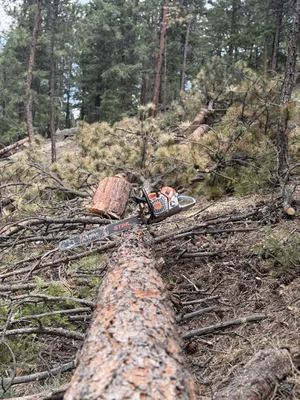
At White Elk Forestry, we can break projects into stages instead of trying to do everything in one shot. We can spend the winter felling selected trees, limbing and bucking timber, and getting material consolidated where it makes sense. Logs can be decked for later use. Slash can be organized for chipping or hauling once access improves.
Then, when the snow melts, we come back and finish the job.
Branches and tops can be chipped or hauled away. Good logs can be cut into firewood rounds for the homeowner or hauled off for other uses. Depending on the property, local regulations, and what’s available, permitted pile burning or community slash collection programs might also be options.
Around Evergreen, Conifer, Pine, and the surrounding mountain communities, having a few different ways to handle that material can make a real difference.
There’s no sense dragging a chipper up an icy driveway in February if we can do that part safely in April. But there’s also no reason to let a good winter felling opportunity go to waste just because the chipper can’t make the trip.
And here’s another part I think homeowners will appreciate: we can bill the work in stages, too.
Rather than paying for the whole project at once, we can agree on the work to be done, complete the winter felling and consolidation, and invoice for that portion. When we return for spring chipping, hauling, or cleanup, that becomes the next phase. It gives folks a little breathing room financially while still getting the work moving.
Of course, we have to be sensible about it. Slash can’t just be piled wherever there’s an empty patch of ground. We need to think about fire safety, access, and how we’ll get it out later. Beetle-infested wood may need to be dealt with sooner, and some properties simply aren’t good candidates for winter work.
That’s all part of figuring out a good plan before the first tree comes down.
I’m not saying every forestry project ought to happen in winter. Far from it. But I do think we let a lot of perfectly good working days slip by waiting for the weather to warm up.
Wildfire mitigation takes time. Doing it well takes a little thought. And neither gets easier when everybody’s in a hurry.
So if you’ve been looking out at those trees all summer, thinking you’ll get around to them eventually, maybe give winter a chance.
Because when the snow finally melts and the warm weather rolls back in, wouldn’t it be nice to sit outside, enjoy your property, and know that work is already behind you?
The snow will melt soon enough.
No reason all the work has to wait for it.
Chris
Owner-Operator
White Elk Forestry, LLC
whiteelkforestry.com
(207) 441-8299
chris@whiteelkforestry.com